 New York Times: In Amanda Downum’s novel DREAMS OF SHREDS AND TATTERS, Liz Drake is a young woman living on the East Coast with her devoted boyfriend, whom she seems a bit ambivalent about which probably explains her rather casual attitude toward him, a casualness that extends to other things as well.
One thing she’s not casual about, however, is her psychic connection to Blake Enderly. When Liz has an intuition, she is absolutely certain that her friend Blake, who lives across the continent and has recently gone missing, is in trouble, so she crosses the country, boyfriend in tow, to help find him. The connection between the two is never fully, or even partially, explained it seems ambiguously metaphorical, a symbol of the fervent tribal bonds of postadolescent friendship, and on that level it does have some resonance. Similarly, the connections between Liz and her other friends are more asserted than earned as the story shifts perspectives, many characters feel like profiles or postures more than fleshy humans, an effect that may be symptomatic or intentional on Downum’s part, or both.
There are hints at a deeper story here, one of drugs and addiction, about getting lost and the depths to which you can go to save your friends. And there are moments of promise, in which Downum successfully blurs the boundary between reality and fantasy until the narrative takes on a dreamlike fluidity, resulting in the freedom of possibility, of real surprise.
 Tor.com: There’s a lot to love about this book and a lot to attract readers with even the vaguest interest in science fiction. […] Christopher has a solid talent at crafting entertaining description. […] Made to Kill is going to be one of those books I pass out like party favors to friends, family, and strangers alike.
 B&N SF&F: The mystery consumed me. I haven’t had this experience reading, really, ever. I somehow forced myself to bed when I was about halfway through. I woke up at three in the morning and read all the way to the end, even my sleeping mind absolutely dying to see what was hiding behind Ren’s teetering wall of deflection and denial. Then I was devastated, sitting alone in my dark house.
 Kirkus: “Don’t forget, it was their choice to get involved in this war”: Fantasian Bennett builds another world, convincingly, in which empires rise and fall and blood flows. Bennett clearly has fun doing all the scene-setting and complicating that his tale involves, and while in the end this is a warning against the totalitarian impulse, it makes all kinds of detours into the dark hearts of men—and women, too. Sometimes too talky but r
 Tor.com: The end result is a series where each installment truly stands out and stands its individual ground as a wildly different sort of text, without ever losing the coherence and engagement of the project as a whole. […] It’s a fast read, compelling, that does interesting work with gender, politics, and human nature; it’s also got a strong plot, thorough research, and delightful characters. Highly recommended conclusion to a great set of books.
 Publishers Weekly: Sometimes the most terrifying horrors are not those involving monsters out of fantasy but those taken straight from today’s headlines. Nijkamp’s debut follows four high school students on their first day of the spring semester in Opportunity, Ala. Over the course of 54 minutes—the amount of time a gunman holds their school hostage—their lives collide. Each of the four has an intimate connection to the shooter, and all must find a way to face the unfolding tragedy. While Claire views the event from outside the school, Autumn, Sylv, and Tomás are on the front lines.
  Publishers Weekly:
  The Monitor: This fascinating novel subverts Pygmalion, rags-to-riches and boy-meets-girl tropes to memorable effect….The narrative style is a delightful pastiche of Georgian and Victorian suffused with striking sensuality and modern sensibilities, as if Charles Dickens and Jane Austen had a child together and raised her on shojo and yaoi manga. The voice of the Pleasure Merchant’s apprentice will stay with you for days.
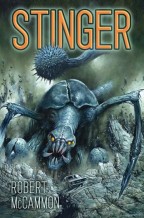 Kirkus: I missed Stinger when in first came out in the late 1980s, but the new reprint from Subterranean Press is the perfect chance to correct that oversight. The story takes place over a 24-hour period in Inferno, Texas—a town that’s already primed for trouble because of racial tension, a poor economy, and gang violence. Things ignite when two unidentified flying objects land nearby, thus beginning a battle in an interstellar war that spells trouble for the small Texas town. The unidentified objects are actually visitors from another world. One of them is an alien bounty hunter known as Stinger, and the complete destruction of an alien town is a small price to pay to capture his deadly prey.