 New York Times: In Amanda Downum’s novel DREAMS OF SHREDS AND TATTERS, Liz Drake is a young woman living on the East Coast with her devoted boyfriend, whom she seems a bit ambivalent about which probably explains her rather casual attitude toward him, a casualness that extends to other things as well.
One thing she’s not casual about, however, is her psychic connection to Blake Enderly. When Liz has an intuition, she is absolutely certain that her friend Blake, who lives across the continent and has recently gone missing, is in trouble, so she crosses the country, boyfriend in tow, to help find him. The connection between the two is never fully, or even partially, explained it seems ambiguously metaphorical, a symbol of the fervent tribal bonds of postadolescent friendship, and on that level it does have some resonance. Similarly, the connections between Liz and her other friends are more asserted than earned as the story shifts perspectives, many characters feel like profiles or postures more than fleshy humans, an effect that may be symptomatic or intentional on Downum’s part, or both.
There are hints at a deeper story here, one of drugs and addiction, about getting lost and the depths to which you can go to save your friends. And there are moments of promise, in which Downum successfully blurs the boundary between reality and fantasy until the narrative takes on a dreamlike fluidity, resulting in the freedom of possibility, of real surprise.
 Director Sharon Lewis will start shooting a film of Brown Girl in the Ring by Nalo Hopkinson this fall. Produced by urbansoul inc, it tells the story of a dystopian Toronto where Ti-Jeanne is chafing under Mami hergrandmother’s overprotective rules. Mami refuses to loosen her hold on Ti-Jeanne until she “sees” her protector spirit, Jab Jab. Ti-Jeanne rejects the spirits and when Tony comes on the scene she falls fast and hard. Ti-Jeanne runs off with Tony to forge a life in the harsh reality of the Burn. A heart wrenching event forces Ti-Jeanne to “see” her spirit and return home…a grown woman.
 Publishers Weekly:
 The Monitor: This fascinating novel subverts Pygmalion, rags-to-riches and boy-meets-girl tropes to memorable effect….The narrative style is a delightful pastiche of Georgian and Victorian suffused with striking sensuality and modern sensibilities, as if Charles Dickens and Jane Austen had a child together and raised her on shojo and yaoi manga. The voice of the Pleasure Merchant’s apprentice will stay with you for days.
 The Aeronaut’s Windlass stays on the New York Times Bestseller’s List at #16 for hardcover, and on the USA Today Best-selling Books list at #16.
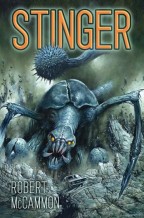 Kirkus: I missed Stinger when in first came out in the late 1980s, but the new reprint from Subterranean Press is the perfect chance to correct that oversight. The story takes place over a 24-hour period in Inferno, Texas—a town that’s already primed for trouble because of racial tension, a poor economy, and gang violence. Things ignite when two unidentified flying objects land nearby, thus beginning a battle in an interstellar war that spells trouble for the small Texas town. The unidentified objects are actually visitors from another world. One of them is an alien bounty hunter known as Stinger, and the complete destruction of an alien town is a small price to pay to capture his deadly prey.
 Locus: Dickinson has taken the gender concerns of Delany, and Delany’s attention to economic/vocational matters and colonialism/imperialism, all set in a pre-technological milieu, and conflated them with some of the aforementioned Cherryh-esque literary/thematic tactics to create a truly fine and distinctively individual fantasy novel that delivers action and philosophy, economics and warfare, love and hatred, in equal measures. His voice, however originally influenced, rings out strong and clear as a new addition to the chorus of fantasists.
 Publishers Weekly:
 Booklist: After barely surviving the events in Koko Takes a Holiday (2014), Koko Martstellar, the world’s most badass mercenary, and her boyfriend, Jedidiah Flynn, are back home trying to live peacefully as the proprietors of the most decadent and violent resort on twenty-sixth-century Earth. Koko wants to leave the killing behind, but there is still a determined bounty hunter out to capture her. So begins Koko’s next cyberpunk adventure, one that is even more dangerous and with bigger stakes than those in her previous outing. Told in an urgent present-tense voice, with alternating viewpoints, this novel is fast paced, action packed, violent, and just plain fun. And since this is a sequel, readers are treated to even more world building and character development, both of which are just as interesting and satisfying as the action-driven plot. Although Koko’s tale is told in words only, it has a graphic-novel storytelling sensibility that will appeal to fans of series like Hellboy or Saga. As the ending implies, we can expect more from Koko in the future, so make sure this crowd-pleasing, well-executed series is on library shelves now.
 Congratulations to Anne Bishop on Daughter of the Blood‘s inclusion on Amazon’s