Oct 062020
 

Locus: One thing about Elizabeth Bear’s Machine, the second novel set in her White Space universe after 2019’s Ancestral Night: it’s sure as hell not either shallow or amoral. It is, in fact, fundamentally engaged in wrestling with questions of ethics, culture, worldview, and how much restitution needs to be made when one does harm in order to do other kinds of good.

Jens is a fascinating character. The narrator of Machine, she is – in all her flaws, determination, skill, friendships, and conviction – very easy to relate to, and to empathise with, in her human complexity, triumphs, and failures.

Though Machine is set in the same world as Ancestral Night – in the Synarche, with its vast diversity of people and species, its peculiar form of government, and its technological advances and social compromises – it has a similarly engaging voice, for all that Jens is a very different character to Ancestral Night’s Haimey, and a similarly engaging approach to pacing: Machine isn’t a short book, but it’s a very fast read for its length. Bear has a striking command of tension and character, and a deep interest in ethics and human behaviour.

It’s impossible, if you’re aware of James White’s Sector General stories and novels, not to see Machine as in conversation with that particular lineage. (I think I’ve read all of one Sector General story, but the influence is clear.) Space opera rarely concerns itself with the medical, and with the challenges of workaday life: it’s an untapped vein, and Bear draws from it with characteristic deftness and skill.

Machine is a fascinating, compelling, and ultimately satisfying space opera in a vast, complex, weird, and interesting universe. I really enjoyed it, and I hope this isn’t the last novel to concern itself with Core General, or with the Synarche at large.

 October 6, 2020  Tagged with: ,
Oct 022020
 

Shelf Awareness: Darcie Little Badger’s creative and meticulously plotted YA debut, Elatsoe, is a supernatural murder mystery that takes place in a United States that has Fairy Ring Transportation Centers, endless fields of scarecrows with human eyes and a rich history of Lipan Apache ghost whisperers.

When Elatsoe’s ghost dog, Kirby, throws a fit, she knows something is very wrong. Turns out, Ellie’s cousin Trevor was in a fatal car accident. That night Ellie, whose “family secret” is the knowledge of how to bring back the dead, dreams of Trevor. “A man named Abe Allerton murdered me,” he tells Ellie. “Don’t let Abe hurt my family.” Ellie’s mother and father believe that Ellie is as powerful as her Six-Great-Grandmother who traveled Lipan Apache territory saving her people from undead evils, dangerous creatures and deadly settlers. Knowing the strength of his daughter’s gift, Ellie’s father agrees to help her investigate. With the assistance of her parents and her good friend and Lord Oberon descendant, Jay, Ellie takes a trip across Texas to find Abe Allerton and bring him to justice.

Little Badger excellently balances humor and horror in this inventive YA mystery/alternate history/fantasy. Ellie is a very likable protagonist whose Lipan heritage and ethnicity is not just twined with the story, but is the story: her gift comes from Six-Great; she’s vocal about the contemporary mistreatment of Indigenous people; and she has a pretty ingenious way of dispelling vampires. Each chapter begins with graceful, almost ethereal black-and-white illustrations by And the Ocean Was Our Sky artist Rovina Cai, adding to the evanescent vibe of the book, a Lipan Apache Sookie Stackhouse for the teen set. One hopes Ellie—and the wonderfully developed world in which she lives—will appear in many more books to come.

 October 2, 2020  Tagged with: ,
Oct 012020
 

Library Journal: This touching story of the love and forgiveness between mothers and daughters will win fans.

 October 1, 2020  Tagged with: ,
Sep 292020
 

Kirkus: The author’s penetrating social critique and deeply felt depiction of one woman’s struggle for self-determination are balanced by her charming take on classic Regency romance…. An expertly concocted mélange of sweet romance and sharp social commentary.

 September 29, 2020  Tagged with: ,
Sep 252020
 

Kirkus: The second novel set in Bear’s sprawling White Space universe – ­after Ancestral Night (2018) – ­is an intricately plotted fusion of science-fiction adventure and conspiratorial mystery that revolves around a space station that begins to experience critical mishaps after a rescue mission returns with humans who have been in cryogenic suspension for centuries.

When rescue specialist Dr. Brookllyn Jens­ – who has dedicated her life to saving and treating any and all species of beings – ­finds more than 10,000 humans in cryo-containers onboard a derelict generation ship that has been in space for 600 years, she is faced with numerous unanswered questions. How did the ship get to its current location? Why were the passengers turned into “corpsicles”? Why was an android named Helen Alloy left to protect them? Why is a modern vessel docked on the generation ship, and where is the methane-breathing crew? What is the purpose of the crablike machine in the vessel? With these mysteries, and more, unsolved, Jens returns as many rescued passengers as she can to Core General, a state-of-the-art hospital and largest constructed biosphere in the galaxy. Once there, however, Jens begins uncovering some chilling revelations about the purpose of the frozen passengers, the strange craboid walker, and a mysterious virus impacting shipmind AIs. While there are a few sequences in which the momentum flags, Bear’s ability to keep the reader immersed in the various characters’ individual stories and the dynamism among the human and alien characters of the Synarche (the interstellar government that joins together multiple alien races for a collective good) more than compensates. The character arc of Jens­ – who has a debilitating pain syndrome and is struggling to come to grips with her lack of connection with her daughter­ – is done with insight and sensitivity.

A page-turning fusion of science fiction and mystery­ – hopefully Bear will revisit her White Space universe soon.

 September 25, 2020  Tagged with: ,
Sep 242020
 

Locus: The Space Between Worlds is fascinating, complicated, compelling, and far too aware of the costs of precarity to be able to end on a triumphant note. But its quiet, personal, hopeful conclusion is more satisfying, in a deep-rooted way, than any conclusion that turns on revolution. This is a jewel of a novel, all the more impressive for being Johnson’s debut.

 September 24, 2020  Tagged with: ,
Sep 172020
 

Booklist: This book pulls apart what a book is, what a book could be, and gets to the soul of what it means to tell a story, all while delivering queer chemistry and intricate worldbuilding.
 September 17, 2020  Tagged with: ,
Sep 112020
 

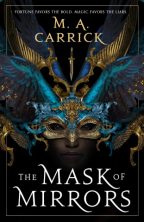
Publishers Weekly: A tightly laced plot dripping with political intrigue. Carrick has built a strong foundation for things to come.

 September 11, 2020  Tagged with: ,
Sep 102020
 

New York Times: THE SPACE BETWEEN WORLDS is Micaiah Johnson’s debut, but that word is utterly insufficient for the blazing, relentless power of this book, suggesting ballroom manners where it should conjure comet tails.

The multiverse is real, and Adam Bosch has figured out how to move people among 382 versions of Earth; his company, Eldridge, extracts information and resources from those worlds. The only catch: You can’t travel to an Earth on which a version of you is still alive. The only people who can become “traversers,” then, are those whose existence is so precarious that they’ve survived in just a few worlds. “They needed trash people,” says Cara, our protagonist, gripping my heart and squeezing. In all the hundreds of Earths Eldridge can access, Cara’s alive in only eight.

Cara is a resident of Wiley City, a walled compound in a postapocalyptic world ground down by numerous wars. In the comfort of its controlled atmosphere and artificial sunlight, citizens and residents enjoy the benefits of a robust social contract, have access to housing and medicine, and enjoy a prosperity bolstered by resources stolen from alternate worlds. Cara’s originally from Ashtown, beyond Wiley City’s gates: a loosely knit community of laborers, scavengers, religious commune members and sex workers, leading hardscrabble lives in an unforgiving desert ruled by an onyx-toothed Blood Emperor and his runners. It takes 10 years of residency in Wiley City before one can apply for citizenship; Cara’s been there for six. But once Eldridge develops the technology to extract information across worlds remotely, traversers will be obsolete and Cara will be banished back to Ashtown. Unless she can make herself indispensable first.

As a metaphor for neoliberal imperialism, this tale is profoundly satisfying; as a work of art, it’s even better. Cara is so mesmerizing a character that I was helpless before every twist and turn of plot, riveted by her pain, love and secrets. The book remained two steps ahead of my imagination, rattling it out of complacency and flooding it with color and heat.

Everything is hard. The news vacillates between horror novel and undisciplined television drama from one hour to the next. But “The Space Between Worlds” and “Dance on Saturday” make me feel profoundly grateful to exist in the same world and at the same time as their authors — to bear witness to the furious compassion and generosity of their power.

 September 10, 2020  Tagged with: ,
Sep 042020
 

Publishers Weekly: Muir (Gideon the Ninth) showcases her distinctive voice in this playful page-turner that flips fairy tale archetypes on their heads. A witch traps Princess Floralinda at the top of a tower, explaining “you have butter-coloured curls and eyes as blue as sapphires. The moment I saw you, I knew a tower was crucial. Witches are all slaves to instinct.” Each of the tower’s 40 floors houses a different type of monster, and the dragon guarding the ground floor is so fearsome that none of the princes coming to rescue Floralinda have been able to make it past. After the princes stop trying, Floralinda discovers the diary of the tower’s previous occupant, another princess who eventually became so despondent she jumped out the tower window to her death. Desperate to escape, Floralinda endeavors to get past the goblins on the floor below her. She succeeds only with the help of Cobweb, a fairy she captures. Together, they make their way down the tower, and along the way Floralinda learns to fight, ask questions, and think for herself—none of which a princess is “meant” to do. Told with the humor, whimsy, and innocent romance of a children’s story, this adult fairy tale is a winsome enchantment.

 September 4, 2020  Tagged with: ,