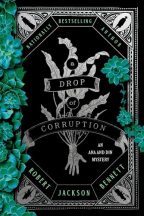
Publishers Weekly: Bennett’s wonderfully clever and compulsively readable sequel to 2024’s The Tainted Cup offers another winning blend of fantasy and classic detection, featuring off-beat sleuths who call to mind Rex Stout’s Nero Wolfe and Archie Goodwin but operate in a realm under constant threat of destruction from eldritch marine creatures known as the leviathans. Ana Dolabra, “a woman so brilliant she lives most of her days blindfolded and rarely leaves her rooms, for fear that common life shall overwhelm her mind,” and her legman, Dinios Kol, who has been genetically augmented with the ability to perfectly recall what he sees and hears, are the Khanum Empire’s go-to case-cracking duo. Bennett again gives them a baffling murder to solve: Immunis Mineti Sujedo, part of a Treasury delegation on a high-stakes mission, vanished from his locked room, only for his partial remains to surface five days later. The investigators must ascertain how he disappeared, who killed him, and why. Other deaths follow, muddying the waters. Bennett skillfully integrates humor and magic into the complex puzzle plot and plays fair with planting clues for the reader. Randall Garrett fans will be hooked. (Apr.)
Library Journal: This cozy fantasy mystery, set in the world of The Goblin Emperor, picks up where the previous book, featuring Witness for the Dead Thara Celehar, left off, with Celehar uncertain of his future after the loss of his abilities from his run-in with a deadly ghoul. But Celehar still has his intelligence, his dogged determination, and his contacts in the city. Serving as his Arch-Prelate’s troubleshooter, Celehar investigates the 50-year complete dysfunction of a city cemetery, gets kidnapped, and finds his abilities have miraculously returned when he faces a dead dragon who needs a witness to bring justice against a corporation capable of bringing down the whole empire. In theory, this series shouldn’t be cozy because Celehar has a knack for ending up in epically awful trouble, but he is such a cozy character, just getting the job done and taking each task as it comes to its conclusion. His self-effacing modesty makes him a delight to follow even as it drives his friends to distraction. VERDICT: Readers who are enthralled with the new cozy fantasy trend or love a cozy mystery will be delighted with Celehar and his latest investigation.
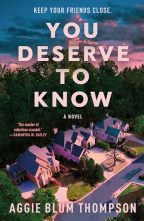
Publishers Weekly: In this captivating standalone from Thompson (Such a Lovely Family), tragedy and scandal rock a neighborhood in the suburbs of Washington, D.C. Gwen Khoury, Aimee Stern, and Lisa Greco-King enjoy weekly get-togethers with their husbands and children, but at one such gathering, tensions rise after Lisa questions Aimee’s parenting and Gwen’s husband, Anton, has too much to drink. At the end of the evening, Anton gets uncomfortably close to Aimee and whispers “You deserve to know” in her ear before leaving. The next day, the police inform Gwen that Anton’s corpse was found near a local bar. Suspecting homicide, investigators question Gwen and Anton’s neighbors, discovering that Aimee’s husband, Scott, was one of the last people to see Anton alive. Soon, the women start to turn on one another, and flashbacks reveal cracks in their friendship that predate the skirmish in the book’s opening scene. Thompson drops her fully fleshed-out characters into a mile-a-minute plot peppered with blindsiding twists, making the novel easy to devour in a single sitting. This is domestic suspense at its finest. (Mar.)
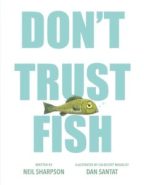
School Library Journal: What makes a good unreliable narrator… in a picture book? One might argue that it’s very much the same qualities that make a good unreliable narrator in a work of fiction for older readers. There’s the choice the author must make as to whether or not to show their hand early or leave the reveal right up until the end. Then there are all the little details that appeared earlier in the book, leaving the reader to doubt everything they were told. That may sound a little heavy for a title whose intended audience is probably still a little unclear on the whole tying-your-shoes deal, but believe me when I say that when it comes to a book like Don’t Trust Fish, I feel inclined to pull out all my literary criticism tips and tricks. There are some picture books that you read that make you chuckle when you see the cover. There are some picture books where they might get one legitimate laugh out of the adult reader. There are some picture books that are funny to young readers. Now consider a book that makes everybody, and I do mean everybody, laugh from the cover onwards. THAT, my friends, is a picture book worth celebrating! That is a rarity! That… is I Don’t Trust Fish.
There are animals in this world that you can rely on. It has fur, is warm-blooded, and feeds its babies milk? That’s a mammal. Cold-blooded with scaly skin and lays eggs? Reptile. Feathers? Birds. Easy peasy. Then… there are fish. Fish don’t follow the usual rules, so you know what that means? “Don’t trust fish!” Don’t trust ‘em! Thanks to this book, you will learn the myriad reasons not to trust these sneaky denizens of the deep. Whale sharks? They’re the size of buses. “That is not okay”. Fish watch us. They plan. They scheme. With scintillating details and delightful art, young readers are given ample reasons not to trust our underwater brethren. But who, precisely, is imparting this information?
Publishers Weekly: Married writing duo Wibberley and Siegemund-Broka (The Breakup Tour) beguile in this empathetic enemies-to-lovers romance. After book marketer Jennifer Worth ends her unsatisfying relationship, she decides to spend a week at an immersive fan experience based on her favorite romantic fantasy series, wanting an escape into a world where love is passionate and real. She’s shocked when she arrives to find her work nemesis, Scott Daniels, also in attendance and cosplaying as one of the men of her dreams. As they search for clues through the elaborate themed scavenger hunt, their constant sparring turns to white-hot attraction. Now Jennifer wonders if her own romantic fantasies, which she’s long dismissed as unrealistic, might be achievable after all—with the one person she least expected to fall for. The authors convincingly portray Jennifer’s romantic angst and Scott’s swoony attempts to woo her. A robust supporting cast rounds out the love story as Jennifer makes new friends who are all as obsessed with the series as she is and becomes embroiled in drama brewing among the experience’s actors. This is a treat. (Feb.)
Publishers Weekly: This animal guidebook send-up starts innocently enough, with a portrait of a dairy cow alongside a simple description of mammalian characteristics: “This animal has fur. This animal is warm-blooded.” Entries for a reptile and bird follow before a page turn reveals an outsize fish. “This is a FISH,” bold-faced type declares. “DON’T TRUST FISH.” Sharpson (When The Sparrow Falls) expands: “Fish don’t follow any rules…. They are rebels and outlaws.” A hint about the screed’s possible source soon appears: “Some fish eat poor, innocent crabs who are just trying to have a nice time in the sea.” Further sins are documented: “The angler fish attracts poor defenseless crabs by glowing. This is called ‘bioluminescence.’ It’s also called ‘cheating.’ ” Caldecott Medalist Santat fires up the comedy with goggle-eyed vignettes of crafty fish, spying fish, disguised fish, and more. “They may already be in your home,” attends an image of a goldfish surveilling a family’s children, then escaping down a tunnel to report to its boss. The claims push ever further into conspiracy territory before the hand-wringing, claw-waving crab is revealed in this rapid-fire comedy of piscine paranoia. Ages 3–7. (Apr.)”
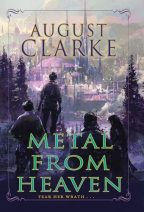
Library Journal: Marney lost her family and her best friend when their employer, ichorite baron Yann Chauncey, broke their strike with a massacre. She, the sole survivor, is lustertouched, a hallucinatory illness that develops in ichorite workers. After building a career as a bandit, Marney sees a chance for revenge when Chauncey’s daughter invites eligible suitors to compete for her hand in marriage. She’ll have to fake a noble identity and conceal her past long enough to outlast the competition, charm an heiress, and strike her enemy down. This novel is a rollicking, anti-capitalist fever dream with vivid prose that grows hallucinogenic at points from Marney’s illness and all-encompassing grief. The worldbuilding is as intricate as the language, with vying factions and different religious traditions that complicate her quest for vengeance.
VERDICT: Clarke’s (“Scapegracers” series, writing as H.A. Clarke) adult debut, an irreverent queer fantasy novel, will thrill readers and appeal to fans of the “Locked Tomb” series by Tamsyn Muir, while the fusion of technology and magic and clash between industrialists and outlaws is reminiscent of Netflix’s Arcane.
Library Journal: Jennifer Worth is a devoted fan of the “Elytheum Courts” series of romantasy novels, so she eagerly seizes the chance to attend a special immersion event for super fans like her. To her utter surprise, her work rival, Scott Daniels—who’s never shown interest in the series—is also there. Their strained professional relationship has always been strictly business, but when they both join a high-stakes scavenger hunt, Jennifer begins to see a different side of Scott. He is no longer the rude coworker who only wants to engage in professional topics; now he seems to be flirting with her. As the competition intensifies, so does the chemistry between Jennifer and Scott, and they both realize that competing against each other has always been fun. Jennifer is left questioning whether their blossoming romance is as magical as the fantasy worlds she adores or if she’s just tricking herself into believing things between them can last in the real world.
VERDICT Readers who enjoyed Sally Thorne’s The Hating Game will love this charming enemies-to-lovers story, and it will be adored by anyone who’s passionate about their favorite book fandoms.
Publishers Weekly:
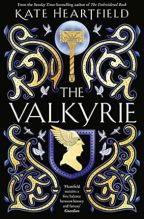
Brave women warriors and diplomats shine in their roles as leaders in this alluring reimagining of Norse mythology from Heartfield (The Embroidered Book). Valkyrie Brynhild has just been exiled from Valhalla by Odin for contradicting his orders. Resigned to the life of a mortal in Midgard, she declares that she will use her wisdom, strength, and rune magic to help those who need protection. Meanwhile, Christian Burgundian princess Gudrun agrees to marry Hun prince Bleda to secure a peaceful alliance—but then Bleda’s brother, Attila, slays him and declares the truce void. In the aftermath, the serpent dragon Fafnir attacks with its poison breath, and Gudrun’s brother, King Gunnar, runs away. With him missing, Gudrun becomes queen and uses her diplomacy skills and knowledge of herbal magic to protect her people. Fortunately, Brynhild and her new friend, Sigurd, the owner of a powerful dragon-killing sword, arrive to help. The complex romances, alliances, and betrayals between Gudrun, Sigurd, Brynhild, and Gunnar intertwine with heartbreaking and tragic results. With a brilliant heroine at the helm, this richly detailed, character-driven story renders epic mythological battles on a human scale. (Oct.)
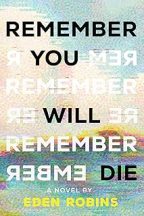
Wall Street Journal: A peculiarity of American fiction is that it is filled with visions of the apocalypse yet lacking in explorations into the experience of death. Writers can imagine the end as a collective catastrophe but rarely as something intimate and individual. A clever, genre-blending book by Eden Robins, “Remember You Will Die” illustrates the paradox. The novel is written as a collection of obituaries of deceased characters from the distant past to the speculative future. Its title derives from the ancient Roman custom of employing slaves to remind triumphant generals of their mortality. Yet the ultimate impression is one of continuity and perpetuation. It’s real interest is in the ingenious ways that humans try to erase death. The novel’s many obituaries—some written in the standard newspaper template, some more informally—hopscotch across time periods, projecting as far ahead as the 22nd century. Gradually the passages create a mosaic of future pandemics and climate crises, as well as of controversial new developments in artificial life and interplanetary colonization. One story outlines the adventures of an outlaw artificial intelligence called Peregrine who, through a process of “in-vitro gametogenesis,” bears a human child. The obituaries dwell on the innovators of these death-defying advances or on avant-garde artists—or both at once, such as Aristotle Williams, a sculptor who invented Peregrine’s “neo-skin.” “Art is emergent, art is a living thing,” declares the maker of huge art installations involving nature. The persistent idea in this book is that life and art are conjoined creative ventures driven by an opposition to death—and often, as in the case of the poppy flower, which flourished on World War I battlefields, growing out of death’s physical residue. Poppies are one of many recurring motifs in this wild, exfoliating book, which jumps around so frantically and contains so many intertextual references that readers will need to take notes to have any chance of keeping up. Ms. Robins has clearly enjoyed herself designing this vast network of connections, which often resembles the art installations it commemorates, full of patterns and puzzles and messages. Its excess and energy make it less a memento mori than a reminder, spelled out in boldface, of the remarkable tenacity of life.