 New York Times: THE SPACE BETWEEN WORLDS is Micaiah Johnson’s debut, but that word is utterly insufficient for the blazing, relentless power of this book, suggesting ballroom manners where it should conjure comet tails.
The multiverse is real, and Adam Bosch has figured out how to move people among 382 versions of Earth; his company, Eldridge, extracts information and resources from those worlds. The only catch: You can’t travel to an Earth on which a version of you is still alive. The only people who can become “traversers,” then, are those whose existence is so precarious that they’ve survived in just a few worlds. “They needed trash people,” says Cara, our protagonist, gripping my heart and squeezing. In all the hundreds of Earths Eldridge can access, Cara’s alive in only eight.
Cara is a resident of Wiley City, a walled compound in a postapocalyptic world ground down by numerous wars. In the comfort of its controlled atmosphere and artificial sunlight, citizens and residents enjoy the benefits of a robust social contract, have access to housing and medicine, and enjoy a prosperity bolstered by resources stolen from alternate worlds. Cara’s originally from Ashtown, beyond Wiley City’s gates: a loosely knit community of laborers, scavengers, religious commune members and sex workers, leading hardscrabble lives in an unforgiving desert ruled by an onyx-toothed Blood Emperor and his runners. It takes 10 years of residency in Wiley City before one can apply for citizenship; Cara’s been there for six. But once Eldridge develops the technology to extract information across worlds remotely, traversers will be obsolete and Cara will be banished back to Ashtown. Unless she can make herself indispensable first.
As a metaphor for neoliberal imperialism, this tale is profoundly satisfying; as a work of art, it’s even better. Cara is so mesmerizing a character that I was helpless before every twist and turn of plot, riveted by her pain, love and secrets. The book remained two steps ahead of my imagination, rattling it out of complacency and flooding it with color and heat.
Everything is hard. The news vacillates between horror novel and undisciplined television drama from one hour to the next. But “The Space Between Worlds” and “Dance on Saturday” make me feel profoundly grateful to exist in the same world and at the same time as their authors — to bear witness to the furious compassion and generosity of their power.
 David Linker at HarperCollins has acquired, in an exclusive submission, Before We Disappear by Shaun David Hutchinson (We Are the Ants), a historical fantasy set during the 1909 Alaska–Yukon–Pacific Exposition in Seattle. Jack, an orphan and magician’s assistant, spies on their rivals to steal secrets of their magic tricks to find that the other magician’s assistant, Wil, can perform real magic. This truth will result in death, so Jack and Wil face the ultimate choice to trust one another or vanish from it all. Publication is set for fall 2021; Katie Shea Boutillier did the deal for world English rights.

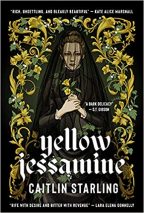 In Yellow Jessamine, shipping magnate Evelyn Perdanu controls the dying city of Delphinium with trade deals and secrets. But when mysterious sickness sparks death and obsession, all leading back to her, Evelyn’s brittle existence is strained to breaking. She retreats to her estate, amidst paranoia and poisonous secrets, intent on rooting out this plague before it destroys everything she has built.

 School Library Journal: In the alternating viewpoints of cool Dre and uptight Dean, Hutchinson takes us into a relationship with more complications than most. Both teenage boys are the only children of vying Presidential candidates and, fittingly, they first meet in an election event green room. Dre, the son of the liberal Latino candidate, is comfortably out to his family and his friends, while Dean’s conservative mother, the opposite candidate, is not gay-friendly and Dean himself, who is white, is only beginning to admit to himself that he’s somewhere on the LGBTQ spectrum. The blossoming friendship between the boys occurs in crossing paths on the campaign trails, in private app chats, and phone calls. Hutchinson imbues all the minor as well as main characters with credible personalities and provides a thoughtful depiction of how different kinds of interpersonal relationships within and beyond families shape individuals and friendships.
 Audio rights to Nnedi Okorafor’s IKENGA, to Kim Budnick at Tantor Media, by Katie Shea Boutillier on behalf of Donald Maass.
 Israeli rights to Annika Martin’s Dangerous Royals Series, to Sifrut Shenogaat, in a three-book deal, by Beverley Levit at The Israeli Association Of Book Publishers Ltd., on behalf of Katie Shea Boutillier for Cameron McClure.
